
Massaman Braised Lamb Shank with Pineapple, Raisins, Peanuts, Sweet Basil & Seasonal Vegetables

his was one of the first things I put on a menu at Farang. It came from one of the early pop-ups and stayed because it worked, a whole lamb shank braised slow in massaman until the meat pulls from the bone with almost no effort. Thailand doesn't use much lamb, but in the UK we have some of the best in the world, and the spices in a massaman paste, cinnamon, cardamom, cloves, star anise, were built for exactly this kind of slow-cooked red meat. It's a natural fit.
Massaman is unlike any other Thai curry in terms of where it came from. The name derives from "Mussulman," an archaic term for Muslim, and the dish traces back to 17th century Thailand, where Persian and Muslim traders brought their spices through the court at Ayutthaya. Those warming spices, the ones that don't appear in a green or red curry, are still in the paste today. National Geographic has a good piece on the history if you want to read further.
The pineapple has to go under a hot grill or onto the BBQ before it goes into the curry. You're after caramelisation, the sugars catching, the flesh taking on some colour and sweetness. Fresh pineapple dropped raw into a braise goes soft and sharp. Roasted pineapple brings sweetness first, then the acidity follows as it stews into the sauce. The same principle I use in the roasted peach massaman on this site. Fruit in massaman is traditional, and getting some caramelisation on it first is the right way to use it.
The raisins I came across in Thailand, served in massaman, and they've stayed in mine ever since. Stew them in from the start so they swell into the sauce. You end up with little bursts of concentrated sweetness as you eat. Different from the pineapple, more like a dried fruit note running through everything. Don't skip them.
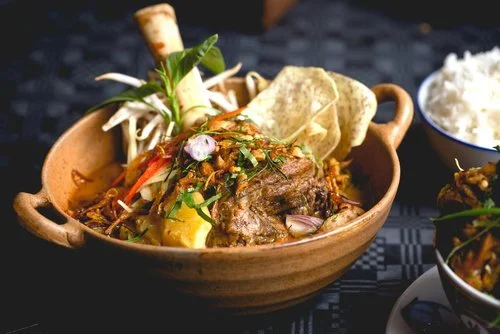
Massaman Braised Lamb Shank with Pineapple, Raisins, Peanuts, Sweet Basil & Seasonal Vegetables
Serves: 2 to 4 | Prep: 20 mins (plus at least 1 hour marinating) | Cook: 2 hours 15 mins
Ingredients
For the lamb
1 large lamb shank, bone-in
50ml kecap manis (substitute with gluten-free soy sauce if needed)
1 teaspoon sea salt
For the curry
100ml coconut oil (or vegetable oil)
25g unsalted roasted peanuts, plus a small handful roughly chopped to garnish
50g palm sugar
2 tablespoons fish sauce
1 litre vegetable stock
400ml coconut cream
150g new potatoes, halved
30g raisins
50g baby sweetcorn, halved lengthwise
50g pineapple, roughly chopped and grilled or charred first
50g green beans, topped, tailed and halved
30ml tamarind water
10g Thai sweet basil leaves, picked
To garnish and serve
Sesame rice crackers
Crispy shallots
Sliced Thai shallots
Beansprouts
10g coriander leaves, picked
Steamed jasmine rice
Method
Rub the lamb shank all over with the kecap manis and sea salt. Leave to marinate for at least an hour at room temperature, or overnight in the fridge. The longer it sits, the more the marinade works into the meat.
Before you start the curry, grill or char the pineapple. Place the pieces under a very hot grill or directly onto a hot BBQ grate and leave them until you get proper caramelisation and some colour on the flesh. Set aside. This is not optional. The caramelisation is what makes it work in the curry.
Heat the coconut oil in a large, heavy casserole dish or deep pot over a high heat. Sear the lamb shank on all sides until deeply browned all over, including the ends. This takes patience, around 10 minutes. Remove and set aside.
In the same oil, add the massaman paste and peanuts. Fry on a medium-high heat for 4 to 5 minutes, stirring constantly, until the paste darkens and the peanuts are golden and fragrant.
Add the palm sugar and stir until it melts and starts to caramelise, darkening the paste further. Add the fish sauce and deglaze, scraping up anything that's caught on the bottom.
Pour in the vegetable stock and half the coconut cream. Stir to combine, then return the lamb shank to the pot, pushing it down into the liquid. It should be mostly submerged. Cover with a lid and braise on the lowest heat your hob will hold for 1 hour 45 minutes to 2 hours, checking occasionally and topping up with a little water or stock if needed. Alternatively, braise in an oven at 160°C with the lid on. The meat is ready when it pulls away from the bone without any resistance.
Add the new potatoes and raisins to the curry and simmer for 10 minutes. Then add the baby sweetcorn, charred pineapple and green beans and continue simmering until the vegetables are just cooked through, around 5 minutes.
Stir in the tamarind water and the remaining coconut cream. Taste. It should be rich and well-seasoned with sweetness from the pineapple and raisins, the sour note of the tamarind coming through underneath. Adjust with more fish sauce if it needs salt, a little more tamarind if it needs sharpness.
Off the heat, fold through the Thai basil. Serve the shank whole over jasmine rice, or pull the meat from the bone and serve it shredded through the curry. Garnish with chopped peanuts, coriander, crispy shallots, sliced Thai shallots, beansprouts and sesame rice crackers at the table.
Chef's notes
At Payst we make a fresh massaman paste that's available for next day delivery across the UK. A fresh paste fries differently to something from a jar, the aromatics are still sharp and the whole curry will taste better for it. Worth using if you can.
The kecap manis gives the lamb a savoury, slightly sweet depth before it even goes near the curry. It's a thick, sweet Indonesian soy sauce and it caramelises beautifully when the shank is seared. If you can't find it, a gluten-free dark soy works in its place, though it won't have the same sweetness.
If you're cooking for a crowd, this scales without any adjustment. Two shanks in the same pot, the same amount of everything else. The braise takes slightly longer but the principle is identical.
For the vegan version of a massaman, the roasted peach massaman is on the site.
This recipe was also published in The Independent and The Evening Standard.
Visit us at faranglondon.co.uk. Sauces and pastes for cooking Thai at home at payst.co.uk.
For more recipes, signed copies of my cookbooks are available at Payst: Cook Thai and Thai in 7.
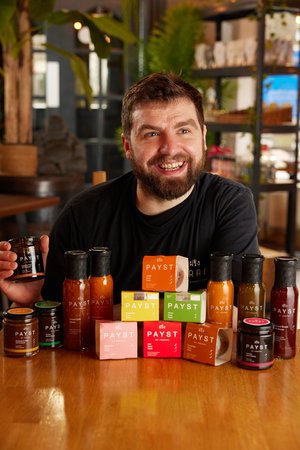
Head chef & founder of Farang London restaurant. Cookbook author of ‘Cook Thai’ & ‘Thai in 7’. Chief curry paste basher and co-founder of Payst London.