
Red Curry of Whole Baby Chicken & Minced Prawns with Sweet Basil & Asian Vegetables
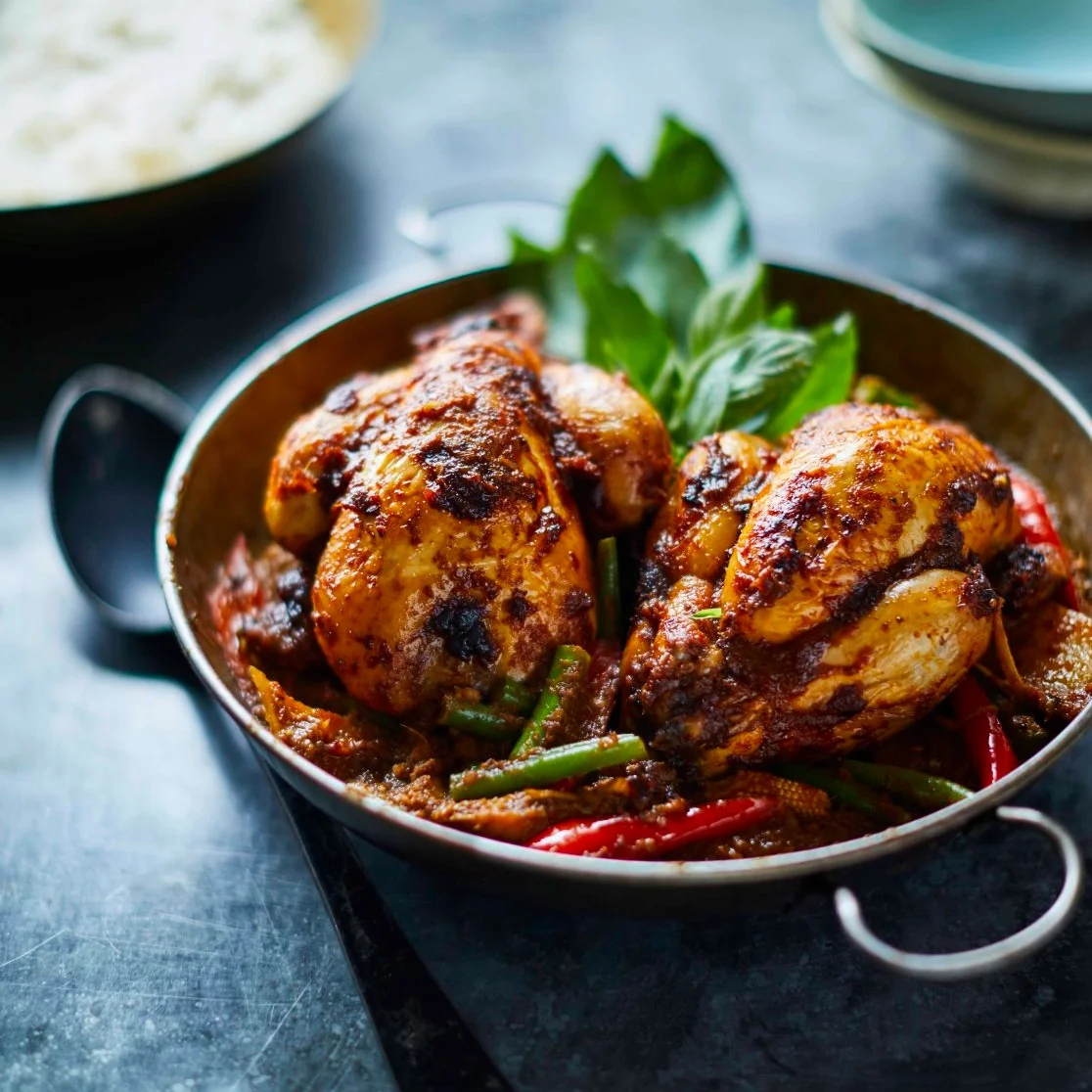
This dish is from the pop-up days of Farang. It's not on the menu any more, but it's the one that people who ate with us at the pop-ups still bring up. A whole baby chicken, marinated overnight in cooked red curry paste, roasted until the skin is charred and the paste is baked into the meat, then pulled apart at the table with a prawn and vegetable curry poured over the top. Sharing food in Thailand is not a serving style, it's a philosophy: everything arrives at the table together, you eat from the same bowl, no one is served individually. This is that dish.
The paste is the foundation. The recipe for Farang's red curry paste is in Cook Thai. If you'd rather buy it, you can get it from Payst. The overnight marinade is not optional if you want the paste to penetrate properly into the meat rather than just sitting on the surface. Cook the paste first in coconut oil until it splits and the raw edge is gone, combine it with prawn stock and coconut cream to make the marinade liquid, then coat the chicken and leave it in the fridge overnight. The flavour difference between an overnight marinade and cooking it straight is significant.
The minced prawn element is what makes this dish unusual. Most Thai curry recipes that include prawn use whole prawns thrown in at the end. Mincing the prawns through a meat cleaver rather than a food processor keeps a rougher, chunkier texture: the cleaver cuts through the fibres cleanly rather than pulverising them into a smooth paste, which means the prawn stays as a distinct presence in the curry rather than disappearing into the sauce. Keep the prawn heads and shells. They go into 500ml of water for 20 minutes to make a quick prawn stock that becomes the cooking liquid for the whole dish. Don't skip this. A prawn stock made from the heads you'd otherwise throw away takes 20 minutes and gives the curry a depth that water or bought stock won't replicate.
Baby chickens, roughly 250 to 300g, are perfect for this: small enough to roast in under an hour, large enough to share between two. A standard supermarket chicken will work but you'll need to adjust the roasting time up accordingly.
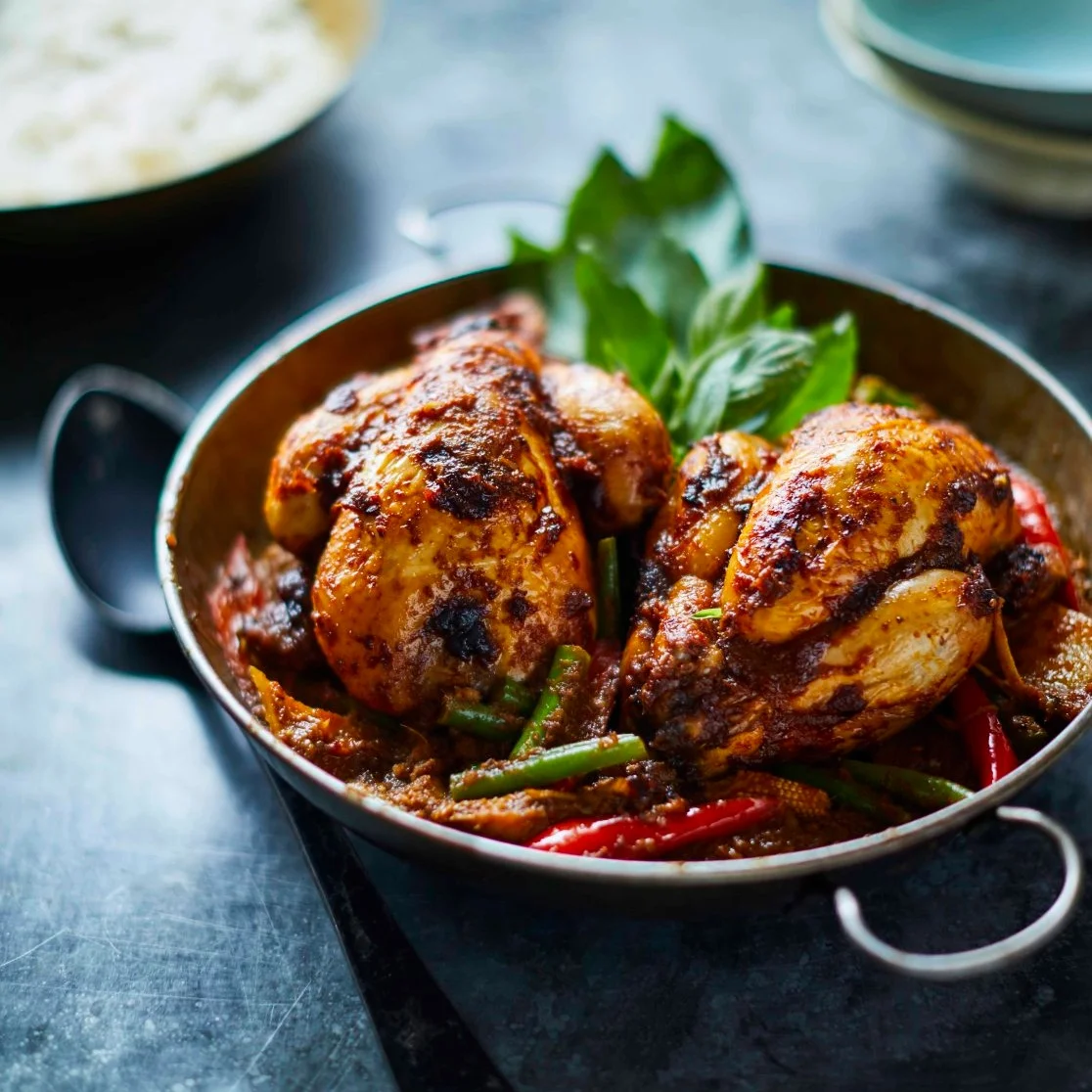
Red Curry of Whole Baby Chicken & Minced Prawns with Sweet Basil & Asian Vegetables
Serves: 2 | Gluten-Free | Prep: 30 mins (plus overnight marinating) | Cook: 1 hr 15 mins
Ingredients
1 baby chicken (roughly 250 to 300g)
200g red curry paste (recipe in Cook Thai, or available from Payst)
1 tablespoon palm sugar
50g whole raw prawns, shells and heads removed and set aside, de-veined, minced with a meat cleaver
20g baby corn, sliced into thin roll-cuts
2 long red chillies, sliced into roll-cuts
2 long green chillies, sliced into roll-cuts
20g green beans, topped, tailed and cut into 2cm chunks
400ml prawn stock (made from the reserved prawn heads and shells, see method)
150ml coconut oil (vegetable oil works but coconut is better here)
500ml thick coconut cream
2 tablespoons wild ginger (krachai), peeled and thinly sliced (regular ginger works)
10g Thai basil, picked
10g coriander, washed and picked
2 to 3 tablespoons fish sauce, to taste
1 teaspoon coarse sea salt
Method
Start with the prawn stock. Put the reserved prawn heads and shells into a small saucepan with 500ml of cold water. Bring to a boil, then reduce to a simmer. Skim off any grey foam that rises to the surface in the first few minutes. Simmer for 20 minutes, then pass through a fine sieve and discard the solids. You should have roughly 400ml of pale, fragrant stock. Set aside.
To mince the prawns, lay them flat on a board and work through them with a heavy meat cleaver using a rocking motion, lifting and turning as you go. Keep chopping until you have a rough, chunky mince with no large pieces remaining. The goal is texture, not a smooth paste. A food processor will work as a shortcut but the texture will be smoother and the prawns will cook faster in the curry: adjust accordingly.
Heat the coconut oil in a wok or large heavy-based pan over a high heat until it shimmers. Add the red curry paste and stir constantly, pressing it into the surface of the wok. Cook for 3 to 4 minutes until the oil begins to separate out from the paste and the colour darkens. The smell should shift from raw and sharp to deeply fragrant. Add the palm sugar and stir for another minute until it caramelises into the paste. Add 2 tablespoons of the fish sauce and cook into the paste for 1 minute more.
Add 200ml of the prawn stock and 300ml of the coconut cream to the pan. Stir to combine, bring to a simmer and cook for 2 minutes. Remove roughly half of this curry base from the pan and set aside to cool. This becomes the marinade.
Once the marinade has cooled to room temperature, pour it over the chicken in a deep dish and turn to coat thoroughly, making sure it gets under the skin at the neck and between the legs and the body. Cover and refrigerate overnight. If you're short of time, 4 hours at room temperature will do something, but overnight in the fridge is noticeably better.
When ready to cook, remove the chicken from the fridge 30 minutes before it goes in the oven. Preheat the oven to 200°C / 180°C fan. Place the chicken breast-side up in a small roasting tray and pour any marinade from the dish over the top. Cover tightly with two layers of foil, sealing the edges. Roast for 35 to 40 minutes, until the skin is bubbling under the foil and the marinade has steamed into the meat. Remove the foil and return to the oven for 10 to 15 minutes until the skin is charred at the edges and deeply coloured from the paste. Check it's cooked by piercing the thigh joint with a skewer: the juices should run clear with no trace of pink. Rest for 10 minutes before serving.
While the chicken rests, finish the curry. Bring the reserved curry base back to a simmer. Add the green beans and baby corn, cover and cook for 5 minutes until just tender. Add the remaining prawn stock and coconut cream, then add the minced prawn. Cook for 2 to 3 minutes, stirring gently, until the prawn is just cooked through and has turned pale pink throughout. Don't overcook it: it tightens quickly. Fold in the Thai basil, krachai, chilli roll-cuts and remaining fish sauce. Taste now: the curry should be properly salty and fragrant, with the prawn coming through distinctly and the krachai giving a clean, herbal note underneath. If it tastes flat, more fish sauce. If the heat is shy, the paste may need a touch more, but add carefully.
Serve the whole chicken in the centre of the table with the prawn and vegetable curry poured over the top. Scatter coriander over and bring the rest of the curry to the table in the wok. Jasmine rice alongside, and nothing else needed.
Chef's notes
The baby chicken size matters. At 250 to 300g, a baby chicken roasts evenly in the time given. Anything larger and the outside will overcook before the inside is done. If you can only find standard chickens, spatchcock it first, which gives you a flatter bird that roasts more evenly, and add 10 to 15 minutes to the covered roasting time.
The foil is protecting the sugars in the curry paste from direct heat, the same principle as the sticky pork ribs. Without it, the marinade burns before the meat is cooked. The char you want comes in the last 10 minutes uncovered, not before.
If you're making red curry paste from scratch, it's in Cook Thai. Make a large batch and freeze it in portions. The paste recipe makes enough for 6 to 8 dishes.
This was the dish that defined the Farang pop-ups. It never came off the menu in the early days because it kept being the thing people came back for. You'll understand why when you eat it.
Visit us at faranglondon.co.uk. Sauces and pastes for cooking Thai at home at payst.co.uk.
For more recipes, signed copies of my cookbooks are available at Payst: Cook Thai and Thai in 7.
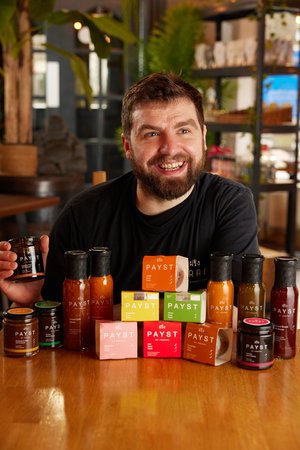
Head chef & founder of Farang London restaurant. Cookbook author of ‘Cook Thai’ & ‘Thai in 7’. Chief curry paste basher and co-founder of Payst London.