
Pomegranate Miang Bites with Ginger, Chilli, Lime, Peanuts & Toasted Coconut

Miang translates roughly as 'one bite wrap' and it's been on the Farang menu since we opened. The idea is simple: sweet, salty, sour and spicy all in a single bite, delivered on a betel leaf. We bring it out early, before the main dishes, because that combination of flavours gets your palate working immediately. It's also one of the easiest things to share. Put a platter in the middle and watch it disappear.
The sauce is a large batch, intentionally. Don't try to scale it down to just what you need for one sitting. Make the full quantity, use what you need to dress the filling, and keep the rest in the fridge. It improves after a day or two and goes through a lot of things: over grilled meats, as a dipping sauce, spooned onto anything that needs sweet, salty depth. It keeps well for a week.
The pomegranate adds juice and a little sharpness in each bite, the seeds bursting against the richness of the sauce. The diced lime goes in skin and all, cut small enough to eat in one piece but sharp enough to cut through the sweetness. The ginger and shallots bring heat and bite. None of this is complicated. It's just well-balanced.
Betel leaves are the traditional wrap. They're peppery and slightly bitter, and that bitterness works against the sweetness of the sauce. You can find them in most Asian supermarkets or order them online without much trouble. Baby gem lettuce is the most practical substitute, large spinach leaves work too, though neither has quite the same flavour or the satisfying cup shape. The dish still works. It's just a different thing.
The turmeric flossed prawns are the garnish that takes this from something good to the version we serve at Farang. Prawns soaked in fish sauce, roasted, chilled and pounded in a pestle and mortar with turmeric until they break down into a light, fragrant floss. Crispy shallots and shredded kaffir lime leaves scattered over the top. It's listed as optional below, but if you're going to the trouble of making the sauce, it's worth doing properly.
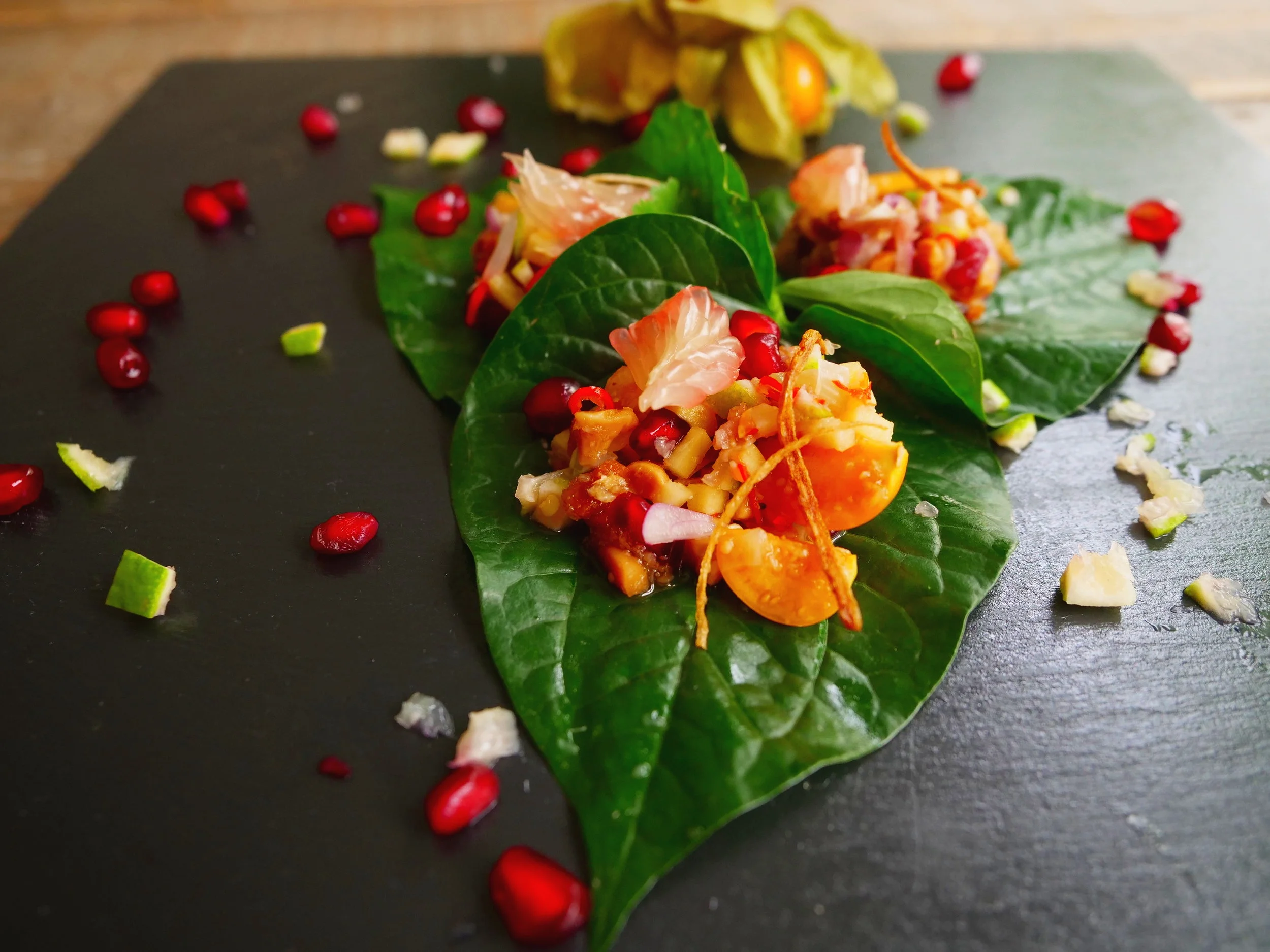
Pomegranate Miang Bites with Ginger, Chilli, Lime, Peanuts & Toasted Coconut
Serves: 4 to 5 as a starter or snack | Prep: 20 mins | Cook: 25 mins
Ingredients
For the miang sauce (makes more than needed, store the rest in the fridge)
150ml tamarind water
500g palm sugar
150g fish sauce (or seaweed sauce for a vegetarian version)
100g toasted peanuts, semi-pounded in a pestle and mortar
100g toasted desiccated coconut
1 tablespoon dried shrimp, pounded to a light floss in a pestle and mortar (omit for vegetarian)
2 green bird's eye chillies
1 teaspoon fermented shrimp paste (gapi) (omit for vegetarian)
For the filling
1cm piece of fresh ginger, peeled and finely diced
6 Thai shallots, peeled and finely diced
½ whole lime, diced small with the skin on
2 tablespoons toasted desiccated coconut
3 tablespoons toasted peanuts, semi-pounded
2 red bird's eye chillies, thinly sliced
A small handful of coriander leaves
1 pomegranate, seeds only, all pith removed
20 betel leaves, washed and dried (or baby gem lettuce leaves, or large spinach leaves)
For the turmeric flossed prawns (optional garnish)
200g raw king prawns, peeled and deveined
2 tablespoons fish sauce
1 teaspoon fresh turmeric, finely grated (or ½ teaspoon dried turmeric)
Crispy shallots, to finish
4 kaffir lime leaves, finely shredded, to finish
Method
Miang sauce
Put the palm sugar, fish sauce and gapi into a medium heavy-bottomed saucepan over a medium heat. Stir regularly. The palm sugar will take a few minutes to melt and the sauce will loosen and darken as it heats.
While the sauce heats, make the dry mix. Put the green bird's eye chillies into a pestle and mortar and pound until broken down. Add the dried shrimp and pound until both reduce to a rough, fragrant floss. Add the toasted coconut and peanuts and pound briefly to combine. You want some texture, not a fine powder.
Once the sauce is bubbling gently and the palm sugar has fully melted, add the tamarind water and stir to combine. Take the pan off the heat briefly. Don't let the sauce caramelise any further at this point or it will thicken too much as it cools and become difficult to work with.
Add the pounded dry mix to the sauce and stir thoroughly to combine. Return to a medium heat and stir for a further 5 minutes until the sauce is bubbling gently again and everything is fully incorporated. Remove from the heat and cool completely to room temperature.
Filling and assembly
Combine the diced ginger, shallots, diced lime, toasted coconut, semi-pounded peanuts, sliced red chillies, coriander leaves and pomegranate seeds in a bowl. Spoon over enough miang sauce to coat everything generously, starting with 4 to 5 tablespoons. Taste it. The mixture should be sweet, salty, sour and spicy all at once. Add more sauce if it needs it.
Place a heaped spoonful of the filling onto each betel leaf and arrange on a serving plate. Serve immediately once assembled. The leaves will start to soften if left to sit.
Turmeric flossed prawns (optional)
Toss the raw prawns in the fish sauce and leave to soak for 15 minutes. Spread onto a baking tray and roast at 200°C / 180°C fan for 8 to 10 minutes until cooked through and starting to catch at the edges. Remove from the oven and chill completely.
Put the chilled prawns into a pestle and mortar with the turmeric. Pound until the prawns break down into a light, fragrant floss. This takes a few minutes. You want it fine enough to scatter loosely over the miang, not a paste.
Scatter the turmeric prawn floss over the assembled miang. Finish with crispy shallots and finely shredded kaffir lime leaves.
Chef's notes
The miang sauce will keep in the fridge for up to a week in a clean sealed jar. It gets better after a day or two as the flavours settle. Use the rest through the week: over grilled chicken or pork, as a dipping sauce, or spooned through a rice salad. It's one of those things that makes a lot of other dishes better.
Gapi is fermented shrimp paste and it's available in most Asian supermarkets, usually in small jars in the ambient aisle. It has a strong smell that mellows significantly in cooking. If you can't find it, the sauce still works without it, but it'll have less depth.
The diced lime goes in skin and all. Cut it into very small pieces so each miang contains a sliver rather than a chunk. The bitterness of the skin is part of what balances the sweetness of the sauce, different from lime juice alone.
Pomegranate seeds are available pre-prepared in most supermarkets if you want to save time. If you're doing it yourself, score the pomegranate into quarters and break it apart in a bowl of cold water. The seeds sink and the pith floats.
Visit us at faranglondon.co.uk. Sauces and pastes for cooking Thai at home at payst.co.uk.
For more recipes, signed copies of my cookbooks are available at Payst: Cook Thai and Thai in 7.

Head chef & founder of Farang London restaurant. Cookbook author of ‘Cook Thai’ & ‘Thai in 7’. Chief curry paste basher and co-founder of Payst London.