
Crispy Chilli & Szechuan Peppercorn Cavolo Nero with Roasted Thai Garlic & Sweet Soy

In Thailand the equivalent of Szechuan pepper is makaen (also written makhwaen), a spice from the same Zanthoxylum family that has been used in northern Thai cooking for centuries. It has a similar mouth-numbing, citrusy quality to Szechuan but with a more floral, orange-forward note and a milder heat. It's the peppercorn that goes into laab spice mixes and northern Thai grilled dishes. I use Szechuan peppercorns in this recipe because they're widely available and the effect is close: that electric, tingling warmth that lifts the whole dish above a standard seasoned kale crisp. If you can find makaen, use it.
Cavolo nero is what I tend to have from the greengrocer when it's in season, but any kale works here. The key is temperature. This is not roasting, it's dehydrating: low heat over a long time until the leaves are light, papery and completely crisp, with the marinade baked into each piece. Too hot and the sugars in the soy and ketjap manis burn before the leaves have dried out, and the whole thing tastes bitter. Spread the leaves on lined trays with space between them, and leave the oven to do the rest.
If your kale or cavolo nero looks tough or bitter when you buy it, put it in the freezer for a few hours before you start. Frost sweetens kale naturally, and the freezer does the same job quickly. The leaves will soften and the bitterness mellows. It's a good habit.
Thai baby garlic is smaller and sweeter than regular garlic, and at Farang we buy it young enough that the skins are thin enough to eat. Roasted until golden and soft, it's a proper garnish here, not an afterthought. Regular garlic works fine if you can't find it.
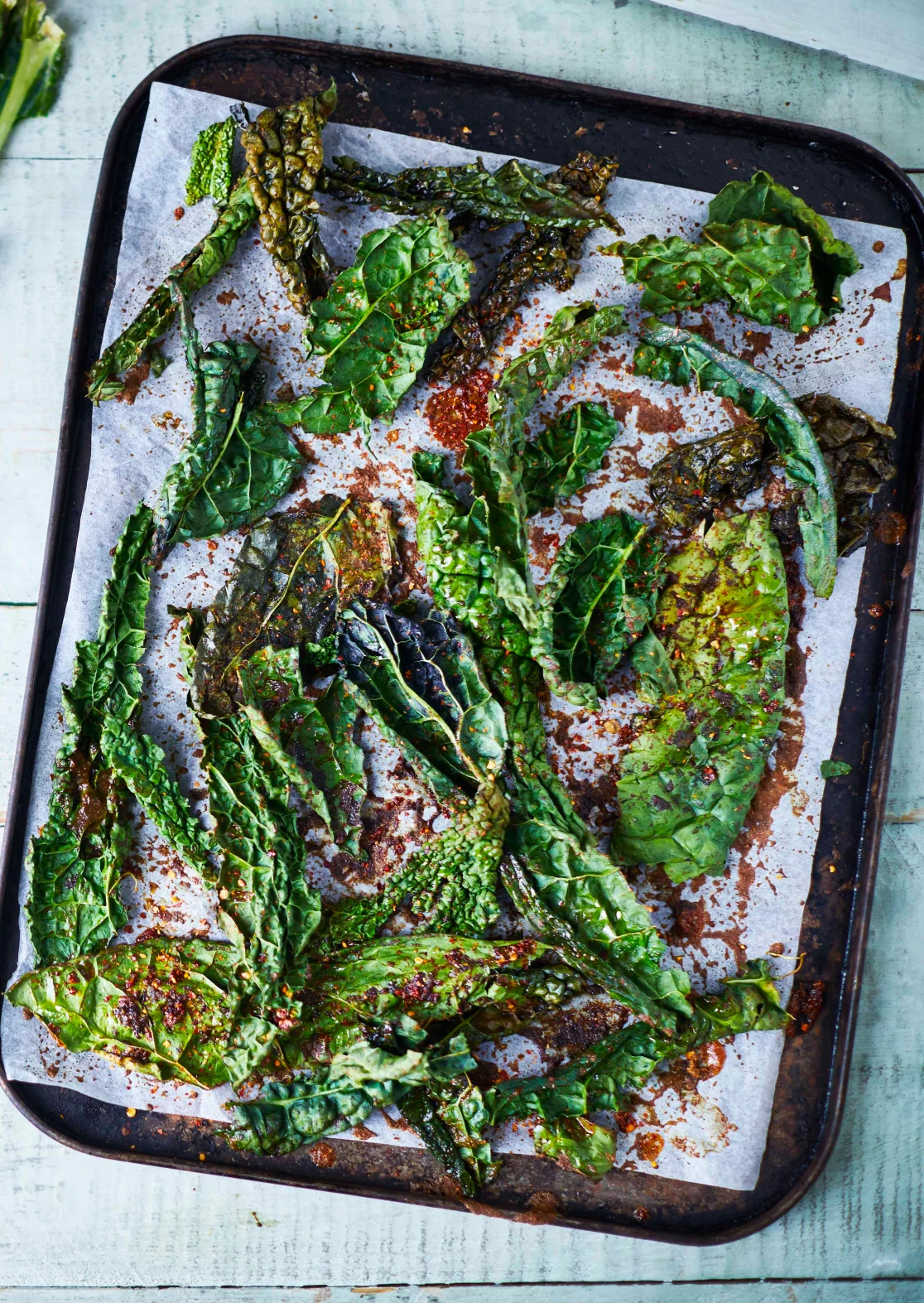
Crispy Chilli & Szechuan Peppercorn Cavolo Nero with Roasted Thai Garlic & Sweet Soy
Serves: 2 to 3 as a snack or side | Prep: 15 mins | Cook: 1 hr 30 mins to 2 hrs
Ingredients
300g cavolo nero (or any kale), thick stems removed, torn into roughly 4cm by 8cm pieces
10 cloves Thai baby garlic, peeled (or 6 cloves regular garlic)
20g fresh ginger, peeled
2 teaspoons coriander root, washed and finely chopped (optional but good)
1 small pinch coarse sea salt
100ml light soy sauce
1 tablespoon ketjap manis (Indonesian sweet soy)
½ teaspoon dried chilli powder
2 teaspoons soft brown sugar
1 teaspoon caster sugar
1 tablespoon sesame oil
1 teaspoon Szechuan peppercorns, toasted in a dry pan and ground to a fine powder
Method
Preheat the oven to 80°C / 60°C fan. Line two or three large baking trays with parchment paper.
Make the marinade paste. Put the garlic cloves, ginger and coriander root into a pestle and mortar with the pinch of coarse sea salt and pound to a rough paste. The salt helps break everything down. Transfer to a large mixing bowl and add the soy sauce, ketjap manis, dried chilli powder, soft brown sugar, caster sugar, sesame oil and ground Szechuan peppercorn. Stir to combine. Taste on your finger now: it should be intensely savoury, slightly sweet with the ketjap manis coming through, and the Szechuan peppercorn should be sitting underneath with that slow, numbing warmth. If it tastes too sharp and salty, add a pinch more sugar. If it tastes flat, the peppercorn may need to be a little more. Set aside.
Add the cavolo nero to the bowl. Get your hands in and work the marinade into every piece, making sure nothing is left uncoated. Squeeze the leaves gently as you go so the marinade soaks in rather than just sitting on the surface. Every piece needs to be covered.
Spread the coated leaves across the lined baking trays in a single layer with space between pieces. Don't pile them. Overlapping pieces steam rather than dehydrate and you'll end up with patches that are soggy rather than crisp.
Put the trays on the lowest shelves and leave to dehydrate for 1 hour 30 minutes, then check. The leaves should be starting to dry and crisp at the edges. If they're still pliable in the centre, give them another 20 to 30 minutes. The total time will be 1 hour 30 minutes to 2 hours depending on your oven. They should feel completely dry and papery to the touch, not leathery. If they're browning or starting to smell bitter, the oven is too hot.
Remove and leave to cool on the trays for 5 minutes before serving. They crisp up further as they cool.
Chef's notes
If you have a dehydrator, use it. Set it to 57 to 60°C and run it for 3 to 4 hours, or leave it overnight for a deeper, more concentrated result. The flavour is noticeably better than the oven method because the leaves dry rather than cook. At Farang we dehydrate at 60°C overnight and the result is exactly what you want: light, papery, intensely seasoned.
For an air fryer with a dehydrate setting: 60°C for 1 to 1 ½ hours works well. If your air fryer doesn't go that low, use the lowest temperature setting it has, check after 20 minutes and every 10 minutes after that. The smaller chamber means they can go faster than the oven.
These are best eaten the same day. If you need to store them, an airtight container at room temperature keeps them crisp for a day or two, but moisture in the air softens them quickly. Don't refrigerate them.
The stems don't go to waste. Thinly slice and pickle them in a quick brine of rice vinegar, sugar and salt for 30 minutes. They work well through salads or alongside a curry.
Szechuan peppercorns are widely available in supermarkets and online. Buy them whole and toast and grind them fresh each time: the pre-ground version loses its numbing quality within weeks of opening. The toasted whole peppercorn ground fresh is a completely different ingredient.
Make double. They go faster than you'd expect.
Visit us at faranglondon.co.uk. Sauces and pastes for cooking Thai at home at payst.co.uk.
For more recipes, signed copies of my cookbooks are available at Payst: Cook Thai and Thai in 7.

Head chef & founder of Farang London restaurant. Cookbook author of ‘Cook Thai’ & ‘Thai in 7’. Chief curry paste basher and co-founder of Payst London.