
How to Plan a Thai Meal at Home
Kitchen Skills
Building a Thai Meal
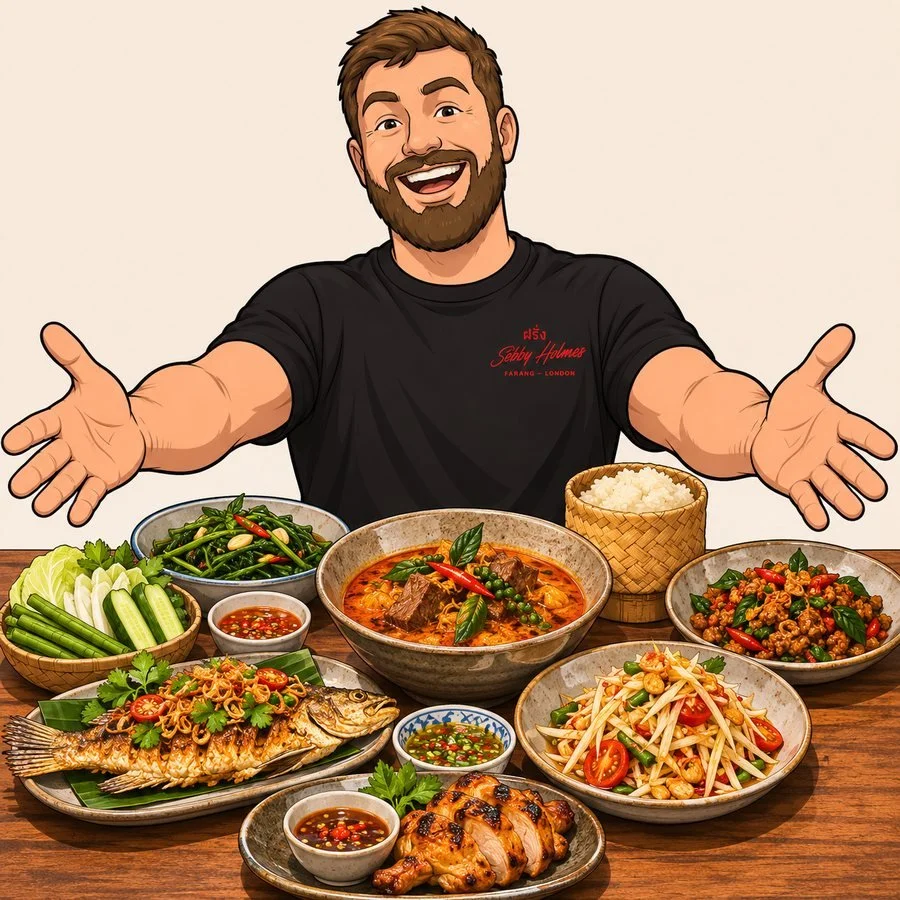
Thai food isn’t one plate each. It’s a table of dishes shared with rice, each one pulling in a different direction. Here’s how to put it together at home without losing your mind.

One curry and some rice is dinner. A curry, a salad, a soup and a nahm prik is a Thai meal.

At a glance
The table
- 1Rice at the centre of everything
- 2Something wet: a curry or a soup
- 3Something fresh and sharp: a salad or nahm prik
- 4Something dry or crisp: a stir-fry, a grill or something fried
How Thais eat
Balance across the table
No single dish has to do everything. The table does it together.
Shared, with rice
Everyone gets a plate of rice. The dishes go in the middle, and you take a little of one at a time to eat with your rice.
Every dish leans
Each dish is balanced in itself, but each one leans a different way. A jungle curry is hot and salty. A salad is sour. A stir-fry is savoury. A fried thing is crisp and mild. Together they balance. More on that in balancing flavour.
Contrast is the trick
Mix it up: hot with mild, rich with sharp, soft with crunchy, soupy with dry. Four dishes with the same texture is boring, however good each one is.
Rice is the point
It isn’t a side. Everything is seasoned to be eaten with it, which is why a spoonful of curry on its own tastes a bit too strong.

Sweet, salty, sour and spicy, all around the rice. Each dish balanced on its own and together, with something soft, crispy, moist and fresh.

It’s how I think about any menu, Thai or not.
The template
Pick one from each
You don’t need a Thai grandmother. You need a template.
| Slot | Pick one |
|---|---|
| Wet | A curry or a soup |
| Fresh | A salad like som tam or laap, or a nahm prik with veg |
| Dry | A stir-fry, a grill, or something fried |
| Rice | Jasmine or sticky |
| On the table | Fish sauce with chillies, pickles, raw veg and herbs |
How much
Roughly one dish per person, plus rice. For two, a curry, a salad and rice is plenty.
Rules of thumb
One properly hot dish and at least one mild one. Only one coconut dish. Sticky rice with northern and Isaan food, jasmine with central curries and stir-fries.

Cooking for two? Curry, salad, rice. That’s still a Thai meal. Stop panicking.
Some ideas
Three tables to try
Three menus that work. Cook one as it is, then start swapping.
Isaan night
Grilled chicken with jaew, som tam, a laap, sticky rice, and a pile of raw veg and herbs.
Bangkok table
A red or green curry, a clear tom yum, morning glory stir-fried in a hot wok, nahm prik kapi with an omelette and veg, and jasmine rice.
Northern feast
Hung lay curry, nahm prik num and ong with pork crackling and veg, pickled mustard greens and sticky rice. A jar of Payst hung lay paste makes the curry easy.
Isaan night is the easiest to pull off. Almost everything is grilled or pounded, and nothing needs to be piping hot.
Full disclosure: Payst is the paste company I run with my brother Tony. Our hung lay won a Great Taste Golden Fork, so I’m allowed to be smug about it.
Timing
Cook it without the panic
The secret is that most of a Thai meal can be done before anyone turns up.
- The day before. Curry, which tastes better tomorrow. Pastes, pickles, nahm prik ong and chilli jam. Soak the sticky rice overnight.
- That morning. Wash and cut all the veg. Pick the herbs. Make the dipping sauces that keep. Marinate anything for the grill.
- An hour before. Rice on. Curry gently warming. Grill lit.
- The last 15 minutes. Pound the som tam, dress the salads, finish the soup with lime off the heat, and stir-fry last of all.
- Relax about temperature. Most Thai dishes are eaten warm or at room temperature. Only the soup and the stir-fry need to be hot.

The stir-fry goes in the wok after everyone’s sat down. It waits for nobody.

Lay everything out in bowls before you start cooking. Ten minutes of stir-frying shouldn’t involve looking for the fish sauce.
Etiquette
How to eat it
A few simple rules, and nobody will mind if you break them.
Spoon and fork
Spoon in your right hand, fork in your left. The fork pushes food onto the spoon, and the spoon goes in your mouth. Chopsticks are for noodle soups.
A little at a time
Take a spoonful or two of one dish and put it next to your rice, eat it, then go for the next. Don’t heap everything on your plate at once.
Soup on the side
Small bowls of soup, sipped between mouthfuls, or a spoonful over your rice.
Sticky rice with your hands
Pinch off a bit, roll it into a ball and use it to scoop.
Season your own
Fish sauce with chilli, sugar and chilli flakes sit on the table so everyone can adjust their own plate.
Piling every dish on your rice at once is the Thai equivalent of pouring custard on your roast.
The fork never goes in your mouth. It’s a pusher, not a stabber.
Questions I get asked
Quick answers
How many dishes do you need for a Thai meal?
Roughly one dish per person, plus rice. For two to four people, three dishes and rice is plenty.
What goes into a typical Thai meal?
Rice, a curry or soup, a salad or nahm prik, a stir-fry, grill or fried dish, and condiments on the table.
Do Thai people eat with chopsticks?
Mostly a spoon and fork. Chopsticks are used for noodle soups.
Should I serve sticky rice or jasmine rice?
Sticky rice with northern and northeastern food like grilled meat, laap and som tam. Jasmine rice with central Thai curries and stir-fries.
Can I make Thai food ahead of time?
Yes. Curries, pastes, pickles and some sauces can be made a day ahead. Stir-fries, salads and the final seasoning of soups are done at the last minute.
Tell me how many you’re feeding and I’ll plan your table.
Now use it
Put it to work
The best way to learn a skill is to cook with it. Start with these, all from my recipe pages.
Further reading: Thai family-style eating, Michelin Guide · Sharing and Thai food culture, TAT News
Keep going
That’s every skill so far. Go back to the start with the wok, or see all the Kitchen Skills.
If you want more of this, subscribe. New recipes, articles and skills straight to your inbox, and my free Thai Pantry guide to get you started.
Sign up here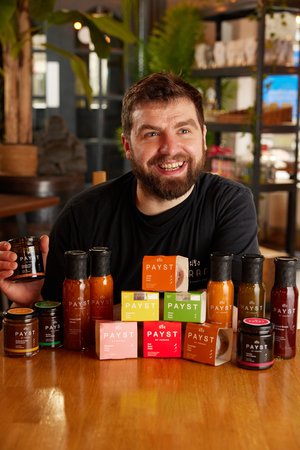
Head chef & founder of Farang London restaurant. Cookbook author of ‘Cook Thai’ & ‘Thai in 7’. Chief curry paste basher and co-founder of Payst London.