
Thai Grilling Over Charcoal
Kitchen Skills
Grilling over Fire
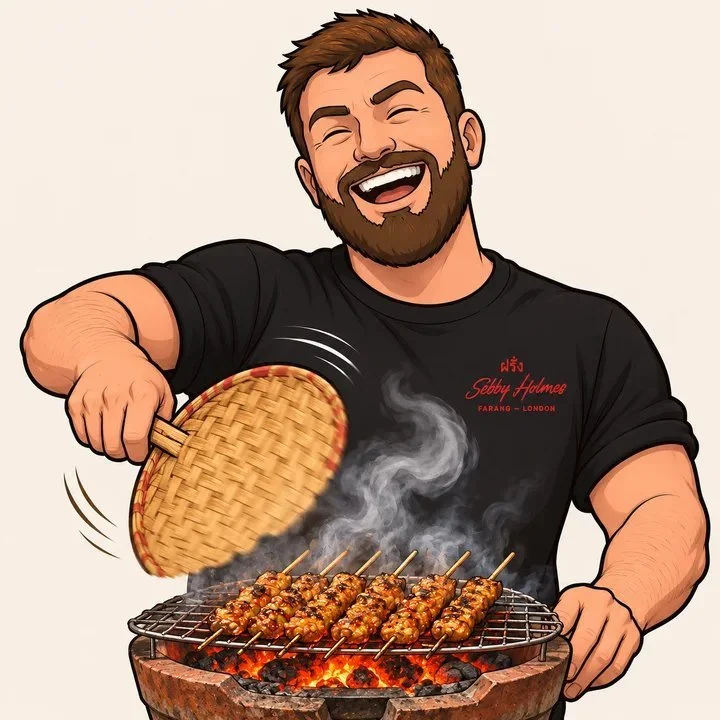
Thai cooks grill on every street corner, over charcoal, with a fan in one hand. Here’s how to light the fire, set it up, marinate, baste and know when it’s done, on a barbecue or in your kitchen.

Getting the barbecue out the minute there’s sun, even if it’s raining at the same time. Very British. Let’s do it the Thai way.

At a glance
How to set up the fire
- 1The hot side: piled coals for searing and charring
- 2The cool side: no coals, lid down, it cooks like an oven
- 3A drip tray, so fat doesn’t flare
The flavour
Smoke, fat and sugar
In a Thai kitchen the grill isn’t an afterthought. It’s half the menu.
Gai yang, moo ping, grilled fish stuffed with lemongrass, pork neck for crying tiger. All of it goes over charcoal. The fat drips, the coals hiss, and the smoke goes straight back into the meat. Add a marinade with sugar and fish sauce in it and the edges caramelise and char. That’s the flavour you’re chasing.
Before I cooked Thai food, a barbecue to me meant burgers and sausages. Once I started cooking in a Thai kitchen, charcoal became part of so many dishes that it changed how I cook everything.
I cook on a Big Green Egg most of the time. It’s a barbecue and smoker in one, and you can hold a temperature for hours. You don’t need one. Any barbecue with a lid works, and a griddle pan indoors gets you the colour, if not the smoke.

Thai street vendors fan the coals with a bit of cardboard. It isn’t for show. More air, more heat.
Step one
Light it properly
Never use lighter fluid. That petrol smell drifting over a British back garden gets into the food.
- Chimney starter. If you’ve got one, use it. Charcoal in the top, scrunched paper in the bottom, light it and leave it. About 15 to 20 minutes.
- No chimney? Build kindling in a criss-cross like a game of Tetris, with a hole in the middle. Scrunched paper underneath, a little charcoal on top, light it. Air coming in from below draws the fire up. Add more charcoal as it catches.
- Wait for white. Leave it alone until the flames have died and the coals are covered in grey-white ash. Cook over flames and you get soot, not char.
- Lumpwood or briquettes. Lumpwood lights faster and burns hotter. Briquettes burn longer and steadier. For quick skewers, lumpwood. For a long cook, briquettes or a mix.

If your eyebrows are still there at the end of the night, you did it right.
The set-up
Hot side, cool side
Never spread the coals across the whole barbecue. You want somewhere to sear and somewhere to escape to.
Pile the coals on one side. That’s the hot side, for searing, charring and crisping skin. The other side has no coals under it. With the lid down it works like an oven, cooking things through gently without burning the outside. Anything that’s browning too fast or flaring up gets moved across.
The hand test
No thermometer? Hold your hand flat about 10cm above the bars and count. One or two seconds before you have to pull away is fierce. Three or four is hot. Five or six is medium.
Vents
Open vents mean more air and more heat. Close them down to cool it. Fully closed puts the fire out, which is also how you save charcoal for next time.
A probe
Never underestimate a probe thermometer. It takes all the guessing out of chicken and pork, and it means you can relax and have a beer.

Most grilling disasters are a one-zone fire. Chicken thighs charred on the outside, raw by the bone. Two zones fixes it.
The extra layer
A bit of wood
Charcoal gives heat. Wood gives smoke. A little of both is the trick.
Which wood
I’ve used cherry wood for years. It suits the spice and sugar in Thai marinades and glazes. Apple and oak work too. Avoid anything resinous like pine.
How much
A small chunk on the coals, or a handful of wood chips. You want a thin blue smoke, not thick white clouds. Thick white smoke tastes bitter.
Coconut
A handful of damp desiccated coconut over the coals gives a sweet, toasty smoke. Try it on chicken.
Indoors
You can’t get real smoke without a fire, but smoked meat in the dish, a little smoked salt or the wok-on-the-barbecue trick from my wok guide get you some of the way.
Wood smoke gets into your hair and clothes for a day. Everyone near you will know what you had for dinner.
The Thai way
Sweet, salty, sticky
Thai grill marinades lean on fish sauce, sugar, garlic, coriander root and white pepper, and they don’t hold back.
Gai yang
Grilled chicken from Isaan. Garlic, coriander root and white pepper pounded together, loosened with fish sauce and soy, with a little sugar. Often a whole spatchcocked bird, eaten with sticky rice and jaew. Good versions of the method from an Isaan cook are worth reading.
Moo ping
Pork skewers, Bangkok’s breakfast. Pork shoulder or neck, sliced thin, marinated with palm sugar, garlic, fish sauce and a splash of coconut milk, which helps it caramelise. Threaded tightly on bamboo skewers and basted with coconut milk as it grills.
Pla pao
Whole fish packed in a thick crust of salt and stuffed with lemongrass and pandan. The crust protects the flesh and steams it from the inside. You peel the skin off and eat the soft fish underneath.
How long
Chicken and pork: at least an hour, overnight is better. Fish and prawns: 20 to 30 minutes, or the salt and acid start to cook them.

Marinade that touched raw meat never goes on as a sauce. Boil it hard first, or keep some back before the meat goes in.

Soak bamboo skewers in water for 30 minutes so they don’t burn through.
On the grill
Sear, move, baste
Sugar in a marinade means it will burn if you leave it over the hot side. So you work it.
- Oil the bars. Scrunch up a wad of kitchen paper, dip it in a little neutral oil, hold it with tongs and wipe it quickly over the hot bars.
- Sear on the hot side. Skin side down first for chicken. Leave it alone until it releases from the bars on its own. If it sticks, it isn’t ready.
- Move to the cool side. Once it’s coloured, lid down, and let it cook through.
- Baste. Brush with marinade, coconut milk or a sticky glaze every few minutes, especially near the end.
- Back over the heat to finish. A last minute over the coals to set the glaze and char the edges.
When is it done?
Chicken thighs and legs are safe at 75°C in the thickest part, but I take them further, to 80°C or more, as the meat round the bone goes sticky and soft. Pork skewers are cooked when there’s no pink and the juices run clear. Fish flakes easily and looks opaque right through. The Food Standards Agency has the full rules on cooking meat safely.
Rest it for five minutes off the heat. The juices settle back into the meat instead of running all over the board.
No barbecue
Griddle pan and grill
You won’t get the smoke indoors, but you can get colour, char and caramelisation, and those are most of what you’re after.
Griddle pan
Heat it properly, for 5 minutes on high, before anything touches it. Don’t move the food until it releases. Thick cuts start on the griddle and finish in a 200°C fan oven.
Oven grill
For skewers and wings, a rack over a foil-lined tray, as close to the grill as you dare, turned often. The foil saves you a horrible scrubbing job.
Open the window
Sugary marinades smoke when they hit a hot griddle. Extractor on full.
After cooking, burn the bars clean over the hot coals, brush them, then oil them once they’re cold. The oil stops rust. If you forget, just do it next time before you cook.
Charred burnt chillies, blistered under a hot grill, make the sauce my chefs pour on everything, crisps included. More in my dipping sauces guide.
Questions I get asked
Quick answers
What is gai yang?
Gai yang is Thai grilled chicken, most famous from the Isaan region in the north-east. It’s marinated in garlic, coriander root, white pepper and fish sauce, grilled over charcoal and eaten with sticky rice and a dipping sauce called jaew.
How do I stop chicken burning on the outside before it’s cooked?
Use a two-zone fire. Sear it over the hot coals, then move it to the side with no coals underneath, put the lid on and let it cook through. Check it with a probe.
What temperature should chicken be on a barbecue?
At least 75°C in the thickest part. Thighs and legs are better taken a little higher, as the meat near the bone softens.
Can I make Thai grilled food without a barbecue?
Yes. A very hot griddle pan or an oven grill gets you colour and char. You lose the smoke, so a pinch of smoked salt or smoked chilli helps.
What do you eat with Thai grilled meat?
Sticky rice, a dipping sauce like jaew, and something fresh and sour on the side, usually a som tam.
Fire won’t get hot enough? Open the bottom vents and stop lifting the lid.
Now use it
Put it to work
The best way to learn a skill is to cook with it. Start with these, all from my recipe pages.
Further reading: Moo ping, SheSimmers · Salt-crusted grilled fish
Keep going
Next skill: how to cook jasmine rice. Grilled meat in Isaan comes with sticky rice, jaew and som tam, so learn those next.
If you want more of this, subscribe. New recipes, articles and skills straight to your inbox, and my free Thai Pantry guide to get you started.
Sign up here
Head chef & founder of Farang London restaurant. Cookbook author of ‘Cook Thai’ & ‘Thai in 7’. Chief curry paste basher and co-founder of Payst London.