
You Don't Hate Coriander. You're Just Looking for Drama.
There is a specific kind of exhaustion that washes over a kitchen when a dish we have spent three days balancing gets dismantled by a dietary requirement that is actually just a tantrum. Coriander is the ultimate victim of this nonsense. It is a loud, bright, aggressive herb and it does not apologise for what it is. It brings a sharp, metallic heat that cuts straight through rich coconut fat and scorched chilli. When a ticket comes back asking us to leave it out, it feels like being asked to play a guitar with half the strings missing. You do not hate coriander. You hate the idea of not being in absolute control of your dinner.
At least that is what I thought for years. Then the science arrived, and I had to do something I am rarely comfortable doing at the pass, which is admit I might have been slightly wrong.
Only slightly.
There is a gene called OR6A2 that makes certain people hypersensitive to a compound in coriander, and yes, it can make the herb taste like soap. The compound responsible is a class of chemicals called aldehydes. Those same aldehydes are found in both coriander and actual soap. So if your nose is built a particular way, what you are smelling in my salad is chemically adjacent to your kitchen sink.. I am not saying this excuses you. But it is at least a coherent biological complaint rather than dinner theatre.
The genome-wide association study that identified this, run across more than 14,000 participants, found a specific genetic variant on chromosome 11 tied to the soapy-taste response. The heritability figure they landed on was around 8.7%. That is not nothing. But it is also nowhere near destiny. Most of the variation in how people experience coriander is not accounted for by genetics at all. A significant portion comes down to something considerably less glamorous than a chromosome: how much of it you have actually eaten in your life.
23andMe surveyed 50,000 people and found that 14 to 21 percent of East Asian, African, and Caucasian respondents disliked coriander. Among South Asian, Hispanic, and Middle Eastern respondents, that number dropped to 3 to 7 percent. Look at a map of global coriander use for about four seconds and the pattern becomes obvious. The cuisines where coriander is non-negotiable, Thai, Vietnamese, Indian, Mexican, Moroccan, produce populations that almost uniformly have no issue with it. The cuisines where it barely appears produce more people who claim it is ruining their life. Funny, that.
What this tells you is that a significant number of people who send it back have simply not eaten enough of it. The body adapts. Repeated exposure changes perception. The first time most people encounter anything pungent and aggressive, proper fish sauce, blue cheese, a well-aged stinky tofu, the reaction is broadly negative. We learn to find the pleasure underneath the shock. Coriander is no different. It just has better organised opposition.
The Facebook group is called "I Hate Coriander." At its peak it had over a million members. There is merchandise. There is an International I Hate Coriander Day on February 24th, which tells you everything you need to know about how much serious persecution some people have encountered in their lives. Julia Child famously said she would pick it out and throw it on the floor, which is a tremendous image, and also worth noting that Julia Child ate like a human being who loved food, so I am not going to hold one herb against her record.
Here is where I land. The gene is real. The soapy response is real for a percentage of people. I am not dismissing that. But the gene is not the whole story, and using it as a blanket excuse has given an enormous number of people permission to stop tasting things properly and call it science. Coriander is not an allergy. It is a herb that has been feeding people for four thousand years and it does not deserve the drama it receives in a North London dining room.
Tell the kitchen, we will leave it out, we deal with worse. But if you simply decided fifteen years ago that you do not like it and have never revisited that position, eat it again somewhere it belongs. In a larb. In a curry. In a bowl of something that has been building for hours. Give it a fair hearing.
You might be surprised.
And do not even get me started on the people who order Thai food and ask us to hold the chilli
If you want more of this, subscribe. New recipes and articles straight to your inbox, and my free Thai Pantry guide to get you started. Sign up here.
Visit us at faranglondon.co.uk. Sauces and pastes for cooking Thai at home at payst.co.uk.
For more recipes, signed copies of my cookbooks are available at Payst: Cook Thai and Thai in 7.
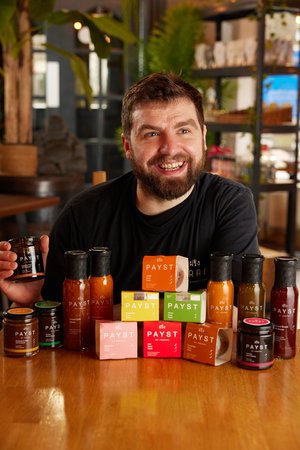
Head chef & founder of Farang London restaurant. Cookbook author of ‘Cook Thai’ & ‘Thai in 7’. Chief curry paste basher and co-founder of Payst London.