
How to Soak Rice Noodles for Pad Thai
Kitchen Skills
Rice Noodles
Soggy, clumpy pad thai is nearly always a noodle problem, not a sauce problem. Get the noodles right and the rest falls into place.

Never boil pad thai noodles. Ever. I will know.

At a glance
Soak, droop, wok
- 1Soak in room-temperature water, not boiling
- 2They’re ready when they droop
- 3Straight into the wok, no boiling first
Shopping
Which noodle is which
Dried rice noodles come in a handful of widths, and each one has its job. Packets are labelled in a mix of Thai, English and guesswork.
| Noodle | Width | Use it for |
|---|---|---|
| Sen mee | thread-thin vermicelli | Soups, salads, spring rolls and some stir-fries |
| Sen lek | about 2mm | Noodle soups like boat noodles, and pad thai at a push |
| Sen chan | about 3 to 5mm | Pad thai |
| Sen yai | wide, 1 to 2cm | Pad see ew, rad na, drunken noodles. Best bought fresh |
| Khanom jeen | round, like spaghetti | Boiled, served cool with curry |
Pad thai noodles are often sold as “rice stick, medium” or “M”. Widths vary from brand to brand, so the soaking times on the next page are a guide. This noodle guide has photos of each one, which helps in the shop.
Glass noodles look similar but they’re made from mung bean starch, not rice. They go clear when cooked and they’re for salads, soups and stir-fries in their own right.

Ignore the cooking instructions on the packet. They’re usually written for boiling, and boiling is how you get mush.

Fresh wide noodles from the chiller in an Asian supermarket are miles better than dried for pad see ew.
Step one
Soak, don’t boil
Thai cooks soak dried noodles in room-temperature water until they bend, then let the wok finish them in the sauce.
- Thin vermicelli, in just-boiled water. Then drain.
- Small, about 2mm.
- Medium, about 3 to 5mm, for pad thai.
- Large, dried 1cm.
Ready when they droop
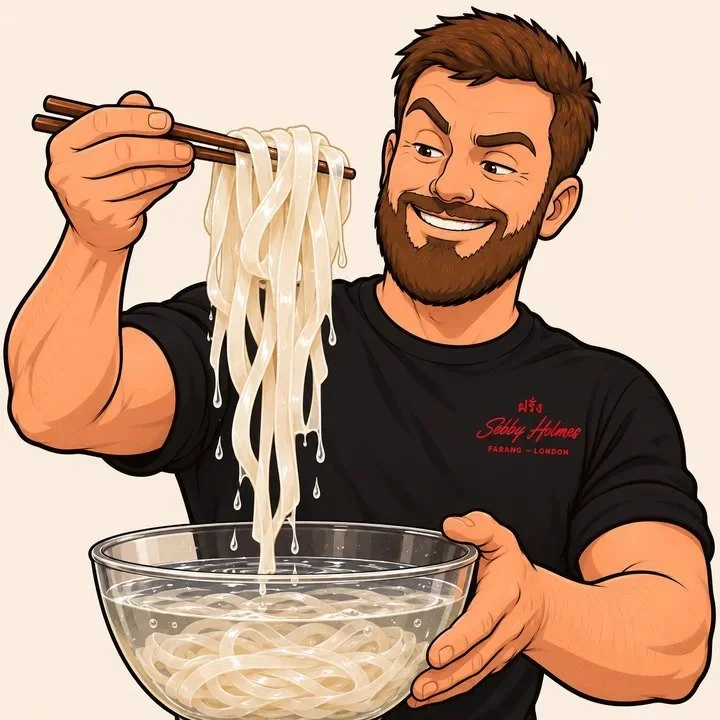
Lift a few out on chopsticks. They’re ready when they hang down limp instead of holding their shape. They should still feel a little firm and white in the middle. The wok does the rest.
In a hurry?
Pour hot water over them off the heat and let them steep. It’s quicker and it’s been tested, but the noodles go softer, which suits soups better than stir-fries.
Drain them well
Shake them dry in a colander. Water dripping into the wok means steamed noodles.

Soak them in the morning, drain them, and keep them covered in the fridge. Dinner is ten minutes away.
Step two
Into the wok
Soaked noodles are delicate. Treat them gently, keep the heat high and don’t crowd them.
- Small batches. Two portions at a time at most. A crowded wok steams the noodles and they clump into one big lump.
- Oil first, hot wok. A properly hot wok with enough oil to coat the noodles. Too little oil and they stick.
- Sauce and a splash of water. Soaked noodles drink liquid as they finish cooking. Add the sauce, then a splash of water at a time, until they’re tender and chewy.
- Push, flip and toss. Don’t stir. A spatula drawn through noodles cuts them into short bits. Lift and fold them over from underneath.
- Taste a strand. Chewy and tender with no hard core. If it’s still firm, a splash more water and another minute.
Pad thai sauce is tamarind, palm sugar and fish sauce, melted together. There’s a whole page on it in my tamarind and palm sugar guide.
Sticking and breaking? Usually the wok isn’t hot enough, there isn’t enough oil, or the seasoning is young. Scraping them off is what breaks them.
Pad see ew wants a little char. Leave the noodles alone for 20 seconds between tosses so they catch.
The famous one
How I serve pad thai
It’s the dish everyone orders and the one most people get wrong at home. Here’s how I do it.
The noodles
Medium rice noodles, soaked, not boiled. Everything on the previous pages.
The sauce
Sour first, then sweet and salty. If it tastes too strong on its own, that’s right. The noodles soften it.
Egg and tofu
Firm tofu and an egg scrambled into the side of the wok before the noodles go back over it.
The garnish
I always finish pad thai with roasted chilli powder, which we call blue tongue at the restaurant. Crushed peanuts, chilli, beansprouts and pickled daikon on the side, and a wedge of lime. Never cook the lime. Squeezed fresh at the table, it lifts everything.
If you want to see where I take it, try my crab and smoked chicken pad thai.

Ketchup in pad thai. I’ve seen it. I’m still not over it.
Other noodles
Fresh noodles and soups
Two more situations you’ll meet.
Fresh wide noodles
They come chilled and stuck together in a block. Break it into chunks and microwave on a plate for about a minute, then peel apart the ones that have softened. Repeat until they’re all separate. Fry one portion at a time.
Noodle soups
Soak the noodles, then dunk them in a sieve in boiling water for a few seconds. Into the bowl, then the hot broth poured over. The broth finishes cooking them. Cooking noodles in the soup pot clouds the broth.
Vermicelli for salads
Soak in just-boiled water, drain, rinse in cold water, drain well. Toss with a little oil so they don’t clump.
Gluten-free
Rice noodles are naturally gluten-free. The sauces often aren’t, so check your soy and oyster sauce.
Fresh noodles keep for a couple of days in the fridge. Don’t freeze them, they go crumbly.
Questions I get asked
Quick answers
How long do you soak rice noodles for pad thai?
About 45 to 60 minutes in room-temperature water, until they’re limp enough to droop but still a little firm. They finish cooking in the wok.
Should I boil rice noodles for pad thai?
No. Boiled noodles go soft and then turn to mush in the wok. Soak them instead.
Why are my rice noodles clumping?
Too many in the wok at once, not enough oil, or wet noodles. Drain them well and cook in small batches.
Can I soak rice noodles in hot water?
You can, and it’s quicker, but they go softer. That’s fine for soups. For stir-fries, a cooler soak gives chewier noodles.
Are rice noodles gluten-free?
Yes, rice noodles are made from rice flour and water. Check the sauces you cook them with, as soy and oyster sauce usually contain wheat.
Noodles came out mushy? Tell me what you did and I’ll tell you why.
Now use it
Put it to work
The best way to learn a skill is to cook with it. Start with these, all from my recipe pages.
Further reading: A guide to Thai rice noodles · Preparing rice noodles
Keep going
Next skill: coconut milk and cream. For pad thai, you’ll want tamarind water and a jar of roasted chilli powder.
If you want more of this, subscribe. New recipes, articles and skills straight to your inbox, and my free Thai Pantry guide to get you started.
Sign up here
Head chef & founder of Farang London restaurant. Cookbook author of ‘Cook Thai’ & ‘Thai in 7’. Chief curry paste basher and co-founder of Payst London.