
How to Deep Fry Safely at Home
Kitchen Skills
Deep Frying
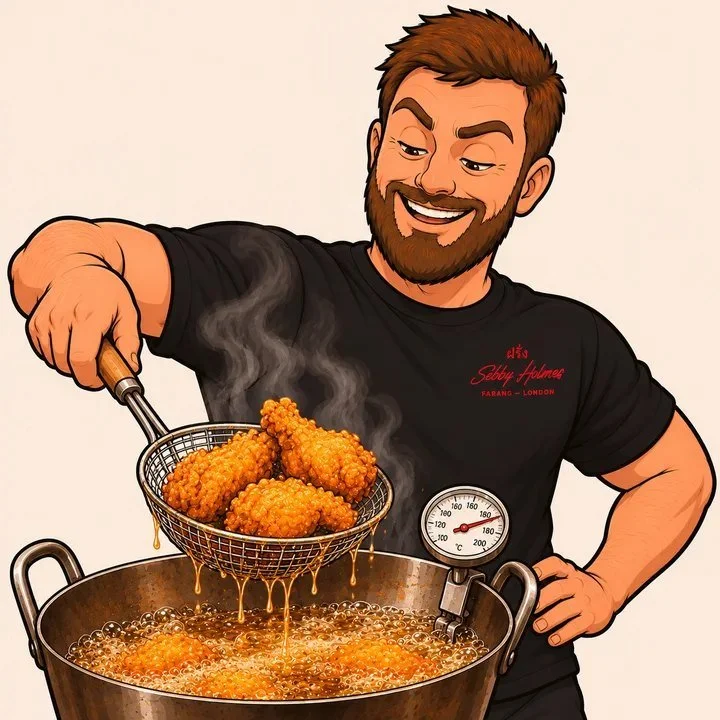
A lot of the best Thai food has been in hot oil: fishcakes, spring rolls, fried chicken, crispy shallots. Here’s how to do it at home, safely, without everything coming out greasy.

Hot oil deserves your full attention. Phone down, no wandering off.

At a glance
Safe, hot and steady
- 1Never fill the pan more than a third full
- 2A clip-on thermometer takes out the guesswork
- 3Bubbles round a wooden chopstick: the oil is ready
Before you start
The pan and the oil
You don’t need a deep fat fryer, but you do need the right pan and a thermometer.
The pan
A deep, heavy pan, or a wok on a wok ring. A wok uses less oil because of its shape, but it must sit steady and never wobble.
How much oil
Never more than a third full. Food froths up when it goes in and you need room for that. It’s also the fire brigade’s advice.
Which oil
Rapeseed oil. It copes with high heat and gets things crispier. Vegetable or groundnut oil work too. Not olive oil.
The rest
A clip-on or probe thermometer, a spider or slotted spoon, and a wire rack over a tray, or two trays lined with kitchen paper.
Electric fryers
A thermostat-controlled electric fryer is the safest way to deep fry at home. If you fry a lot, it’s worth it.

A probe thermometer is the most useful thing you can buy for Thai cooking. Oil, meat, fish, sugar. It earns its keep.
The key to crisp
Get the heat right
Too cool and food soaks up oil. Too hot and it burns outside before the middle cooks.
- Crispy shallots and garlic go in here, as the oil is still rising. More in my crispy shallots guide.
- Thick things that need cooking through, like bone-in chicken, on the first fry.
- Most frying: fishcakes, spring rolls, prawns, tempura.
- A short second fry to crisp things up just before serving. Curry leaves go in at 180°C for a few seconds.
No thermometer?
Stand a dry wooden chopstick in the oil. A steady stream of small bubbles round it means it’s ready. A cube of bread that browns in about 10 seconds means you’re near 180°C.
Fry in batches
Too much in at once drops the temperature and everything goes greasy. Let the oil come back up between batches and skim out any bits.

If the oil starts smoking, turn the heat off straight away. That’s the step before it catches fire.
The Thai crunch
Rice flour and other tricks
A few things Thai cooks do to get that glassy, shattering crunch.
Rice flour or cornflour
Both fry up light and crisp and both are gluten-free, so swap one for the other freely. Tapioca starch is similar. Plain flour gives a thicker, softer crust.
Coconut milk first
Dip whatever you’re frying in a little coconut milk before the flour. It grips the coating better than a marinade does and holds more of it.
Batter
Rice flour and very cold sparkling water, or beer, mixed until just combined. Lumps are fine. Cold batter in hot oil is what makes it crisp.
Fry twice
Cook it through at a lower heat, rest it on a rack, then fry it again hotter for a minute to crisp up. It’s how good fried chicken stays crunchy, and Hat Yai fried chicken from the south is a classic of the method.
Dry food fries better
Pat everything dry. Water makes the oil spit and steams the coating soft.

Hat Yai fried chicken with a handful of crispy shallots on top. That’s the dream.
Sweet marinades brown fast. Fry those a little cooler.
Straight out of the oil
Drain it properly
Most greasy fried food is badly drained, not badly fried.
- Shake it. Lift it out with a spider and give it a good shake over the pan.
- Rack or two trays. A wire rack lets oil drip away and keeps the bottom crisp. Or line two trays with kitchen paper, spread it on the first, then move it to the second after a minute so it isn’t sitting in oil.
- Season while hot. Salt, or chilli salt, straight away, while the surface is still slightly oily so it sticks.
- Serve fast. Crispy things go soft in steam. Don’t cover them and don’t stack them.

Kitchen paper piled on top of hot fried food. You’ve just made a steamer.
Read this one
If it goes wrong
Pan fires happen fast. Know what to do before you start.
Never use water
Water on burning oil causes a fireball. Never throw water on it, and never try to carry the pan outside.
If it catches fire
Turn the heat off only if you can do it safely, without leaning over the pan. Get out, close the kitchen door behind you, and call 999. That’s current fire brigade advice. Don’t tackle it yourself.
Never leave it
Not even for a minute. Turn the heat off if you need to step away.
Kids and pets
Out of the kitchen. Pan handles turned in.
Wet food
Ice, frozen food and wet hands near hot oil make it spit and surge. Dry everything.
Old advice was a damp tea towel over a pan fire. Fire brigades now say get out and call 999.
Afterwards
Reusing and binning oil
You don’t have to throw it away after one go.
Reusing
Let it cool completely, strain it through a fine sieve or a bit of muslin, and keep it in a sealed jar or bottle. Use it a few times, then bin it once it darkens, smells off or starts to foam.
Keep it separate
Fish oil for fish. Oil from crispy shallots and garlic is a seasoning in itself, so keep it for stir-fries and dressings.
Binning it
Cool, sealed in a container, into the general rubbish, or to the recycling centre if yours takes cooking oil. Never down the sink. It sets in the pipes.
Garlic and shallot oil from a batch of crispy shallots is one of the best things in my fridge.
Questions I get asked
Quick answers
What is the best oil for deep frying?
A neutral oil with a high smoke point. I use rapeseed oil. Vegetable and groundnut oil also work.
What temperature should oil be for deep frying?
Most things fry at 170 to 180°C. Thick or bone-in pieces start at around 160°C to cook through, then get a short second fry hotter.
How do I know oil is hot enough without a thermometer?
Stand a dry wooden chopstick in it. A steady stream of small bubbles means it’s ready. A cube of bread browning in about 10 seconds means roughly 180°C.
Why is my fried food greasy?
The oil was too cool, too much food went in at once, or it wasn’t drained properly. Fry in batches and let the oil come back up to heat.
What do I do if a pan of oil catches fire?
Never use water. Turn off the heat only if it’s safe to do so, get out, close the door and call 999.
Batter going soggy? Ask me. It’s nearly always the oil temperature.
Now use it
Put it to work
The best way to learn a skill is to cook with it. Start with these, all from my recipe pages.
Further reading: Deep frying with confidence · Pan fire safety, London Fire Brigade
Keep going
Next skill: toasted rice powder and roasted chilli powder. Fried food needs a good dipping sauce, and your oil is halfway to crispy shallots.
If you want more of this, subscribe. New recipes, articles and skills straight to your inbox, and my free Thai Pantry guide to get you started.
Sign up here
Head chef & founder of Farang London restaurant. Cookbook author of ‘Cook Thai’ & ‘Thai in 7’. Chief curry paste basher and co-founder of Payst London.